$0.00
0 items
If you’ve spent any time comparing Telegram signal copiers, you’ve already noticed the problem: every product claims to be the fastest, smartest, and most reliable option on the market. Some are making claims that don’t survive basic scrutiny. This guide is written to help you cut through the noise, understand what the technology actually does, […]
If you’ve spent any time comparing Telegram signal copiers, you’ve already noticed the problem: every product claims to be the fastest, smartest, and most reliable option on the market. Some are making claims that don’t survive basic scrutiny. This guide is written to help you cut through the noise, understand what the technology actually does, and make a decision based on real criteria — not marketing numbers.
Before you look at any other feature, this is the architecture question that determines your day-to-day experience.
Desktop copiers run as software on your Windows PC or a VPS. When your computer sleeps, crashes, or loses internet, the copier stops working. Signals that arrive while you’re offline get missed. If you’re running this on a VPS, that’s an additional monthly cost on top of the copier subscription. Many traders don’t realize this until they’ve already missed a trade because their home internet dropped at 2am.
Cloud-based copiers run on remote servers 24 hours a day. You log in through a browser to manage settings. Your computer can be off. Your internet can be down. The copier keeps running. Signals get processed and orders get placed regardless of what’s happening on your end.
This distinction matters more than any single feature comparison. A desktop copier with better parsing still requires you to maintain uptime infrastructure. A cloud-based copier removes that problem entirely.
TelegramFXCopier.io is cloud-based. No VPS required. No Windows requirement. It runs continuously on managed infrastructure, which means the question “is my copier running right now?” is one you never have to ask.
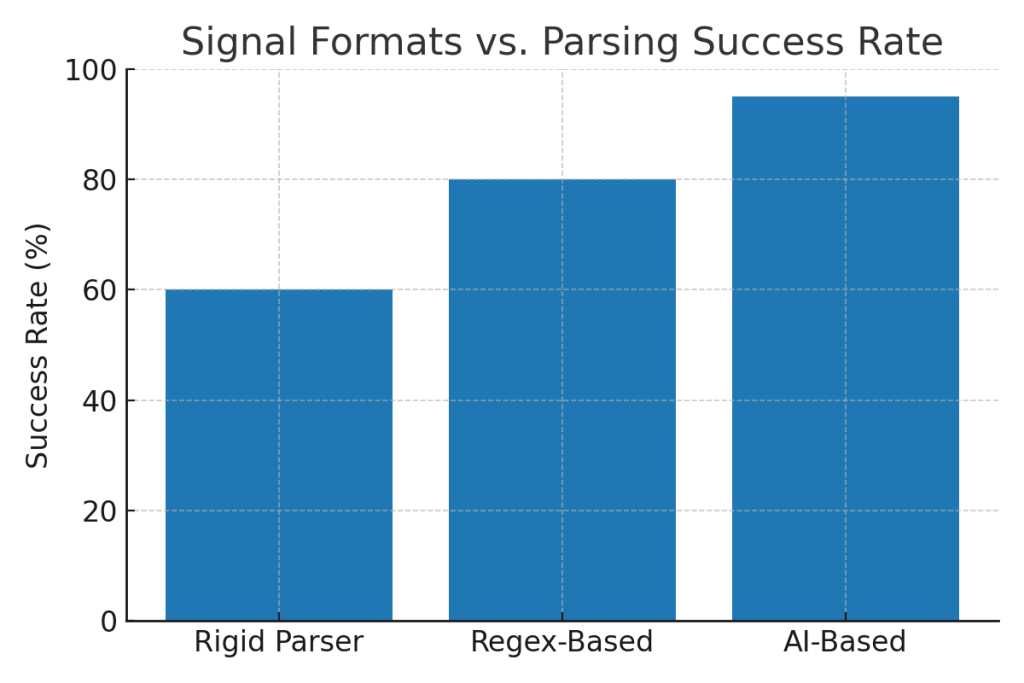
Telegram signal providers don’t follow a standard format. One channel might post:
XAUUSD SELL Entry: 1933.50 TP: 1925.00 SL: 1938.00 Another drops:
Buy EURUSD 1.0845 | TP 1.0880 | SL 1.0820 And a third sends screenshots with text overlays, or uses bold formatting, or prefixes prices with dollar signs. A rigid parser that only understands one format will silently fail on everything else — and you won’t always know it failed until you check your account and the trade isn’t there.
What to look for: AI-based or pattern-recognition parsing that handles format variations automatically, including bold markdown text, prefixed currency symbols, non-standard delimiters, and partial signals (entry only, or TP/SL updates to existing positions).
TelegramFXCopier.io uses an AI-based parser that handles the full range of real-world signal formats. When a new format causes a parsing failure, it’s treated as a support issue and addressed — not left as a known limitation.
This is where you need to read carefully, because some of what you’ll see advertised is not technically possible.
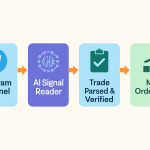
A Telegram signal copier has to complete several steps between the moment a signal is posted and the moment an order is placed with your broker:
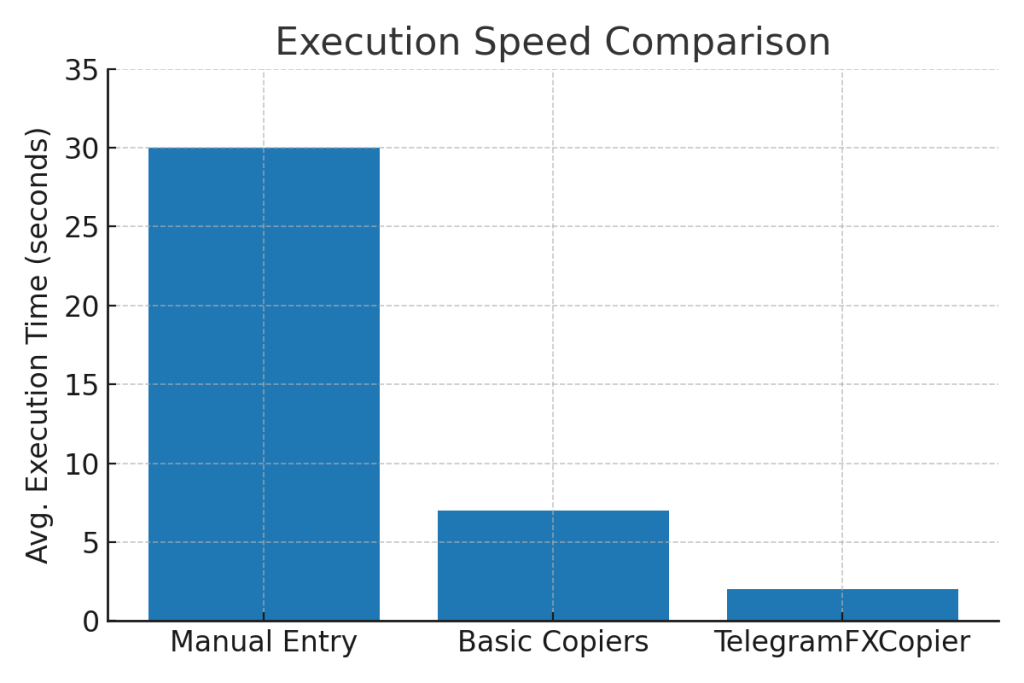
Each of these steps takes time. Network latency alone — the round-trip time between servers on different continents — typically runs 20–100ms depending on geography. Telegram’s own delivery infrastructure introduces additional variable delay. Broker APIs add processing time on their end.
When a company claims execution in the low single-digit milliseconds, they are either measuring only one of these steps (usually their internal server processing time, not end-to-end), or the number is not real. An end-to-end execution time that beats fundamental network physics is not a feature — it’s a marketing claim that doesn’t hold up to basic scrutiny.
What this means practically: focus less on the advertised number and more on consistency. A copier that executes reliably at a realistic speed, with low variance between signals, is more valuable than one claiming an impossible benchmark. Ask whether the company publishes methodology for how their speed is measured. If they don’t, the number is not meaningful.
Most basic copiers read the signal and submit the order exactly as written. This works until it doesn’t — and it fails more often than you’d expect in live trading conditions.
Common failure scenarios:
TelegramFXCopier.io handles these cases through what we call Dynamic Order Flow — a rules engine that compares signal intent against current market conditions and broker requirements before placing the order. This means:
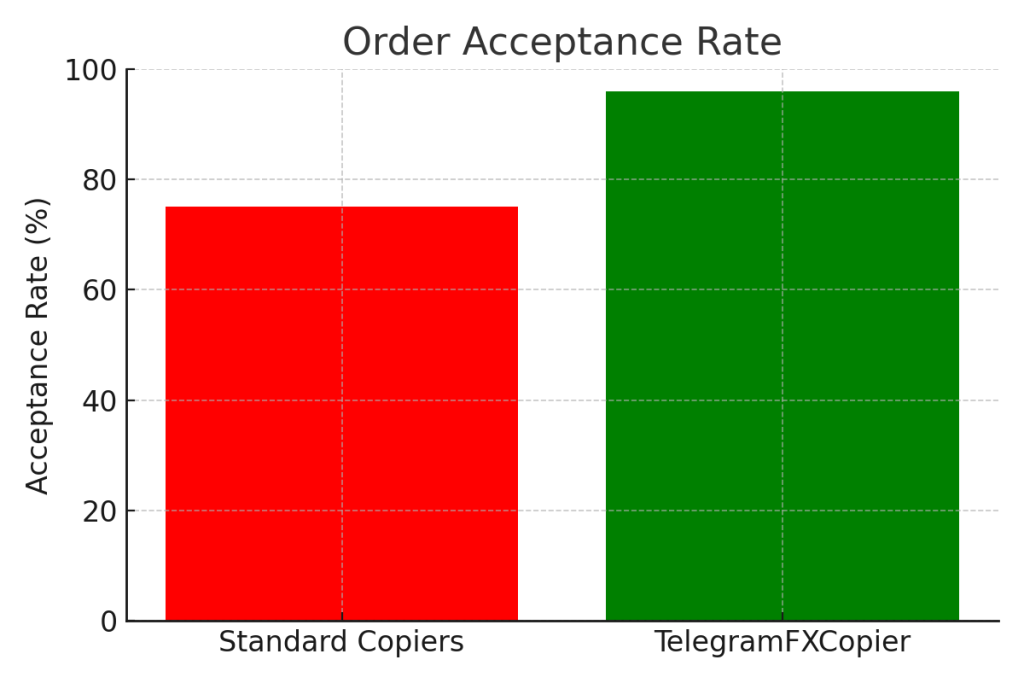
This is especially important if you follow channels that post signals quickly after market moves — by the time the signal reaches you, the entry price may already be invalid. Without intelligent order handling, those trades simply fail silently.
Check this before anything else: does the copier support your broker and trading platform?
MT4 and MT5 are the most common. Most copiers support both. TelegramFXCopier.io supports both through MetaAPI integration, which covers the large majority of retail forex brokers.
cTrader, DXTrade, TradeLocker — these are less commonly supported. If your broker runs on one of these platforms, verify compatibility explicitly before subscribing to anything.
Prop firm accounts — this is increasingly relevant as more traders use funded accounts. Some prop firms have restrictions on third-party tools or API connections. Verify with your prop firm before connecting any external copier.
Symbol mapping — brokers use different naming conventions for the same instrument. GOLD on one broker is XAUUSD on another. XAUUSD.r on a third. A good copier handles this automatically or gives you clean manual controls to set it up. If symbol mapping isn’t handled correctly, orders get placed on the wrong instrument or rejected entirely.
Before choosing a Telegram signal copier, get clear answers on these:
Architecture
Parsing
Execution
Compatibility
Support
What is a Telegram signal copier? A Telegram signal copier is software that monitors a Telegram channel for trading signals and automatically executes the corresponding trades on your MT4 or MT5 account. It eliminates the need to manually copy and enter signals, reducing delay and human error.
Do I need a VPS to use a Telegram signal copier? It depends on the product. Desktop-based copiers require a Windows PC or VPS running continuously. Cloud-based copiers like TelegramFXCopier.io run on managed servers — no VPS or local machine required.
Is there a free Telegram signal copier? Some copiers offer free tiers with limited functionality — typically a single channel, limited trade volume, or reduced features. For serious signal following across multiple channels with reliable execution, a paid plan is generally necessary. TelegramFXCopier.io offers a demo mode to test the platform before committing.
Does it work with MT4 and MT5? Yes. TelegramFXCopier.io supports both MT4 and MT5 through MetaAPI integration, covering the large majority of retail forex brokers.
How do I copy signals from Telegram to MT5? With a cloud-based copier like TelegramFXCopier.io: connect your MT5 account via MetaAPI, add the Telegram channels you want to follow, configure your risk settings (lot size, stop loss handling, etc.), and the system handles the rest automatically.
Can I use a Telegram signal copier with a prop firm account? This depends on the prop firm’s rules. Some allow third-party tools with API connections; others restrict them. Check your prop firm’s terms before connecting any external service.
What happens if a signal arrives with an outdated entry price? A basic copier submits the order as-is and it gets rejected by the broker. TelegramFXCopier.io’s Dynamic Order Flow evaluates current market conditions against the signal intent and adjusts the order type accordingly to maximize the chance of a valid fill.
How is execution speed actually measured? Be cautious of any speed claim that doesn’t specify what’s being measured. True end-to-end execution — from Telegram message delivery to broker order confirmation — involves multiple network hops and cannot be reduced to single-digit milliseconds in real-world conditions. Server-side processing time (how fast the copier handles the signal after it’s received) is a different and smaller measurement. Ask any provider to clarify which metric they’re publishing.
The best Telegram signal copier for you depends on your setup: your broker, your platform, your signal providers’ formats, and whether you want to manage server infrastructure or let someone else handle it.
If you’re comparing options, start with the architecture question — cloud vs desktop — because that decision affects everything else. Then verify parsing flexibility against your actual signal channels, confirm broker compatibility, and ask hard questions about how execution speed is actually measured before treating any number as meaningful.
TelegramFXCopier.io is a cloud-based copier supporting MT4 and MT5, with AI-based signal parsing, Dynamic Order Flow for intelligent order handling, and no VPS requirement. You can test it in demo mode before subscribing.
 Sign in