$0.00
0 items
Telegram copy trading gets marketed as passive income. Set it up, walk away, watch the equity curve climb while you do something else with your life. Sit on the beach or whatever. That’s not what it is. Telegram copy trading is delegated trading. You delegated the decision — what to buy, when, at what price. […]
Telegram copy trading gets marketed as passive income. Set it up, walk away, watch the equity curve climb while you do something else with your life. Sit on the beach or whatever.
That’s not what it is.
Telegram copy trading is delegated trading. You delegated the decision — what to buy, when, at what price. You did not delegate the operation. And the operation is real work, which is why every trading firm large enough to have a logo employs people whose entire job is making sure orders actually land at the broker. Reconciliation. Symbol normalization. Rejection handling. Latency monitoring. That team doesn’t evaporate because you’re a retail trader with a Telegram channel and telegram copy trading software. It just becomes you.
The good news is that it’s maybe fifteen minutes of setup and a periodic sanity check, not a headcount. The bad news is that fifteen minutes is fifteen minutes more than most people spend.
We’ve built all three sides of this thing. We built the copier (TelegramFX Copier). We built the analytics platform for vetting the people sending you signals (mltiplAI). And we’ve built risk automation systems for the forex brokers sitting on the other side of your trades — meaning we’ve seen the machinery that decides whether your order gets filled, and we’ve seen it from the side you don’t get to look at.
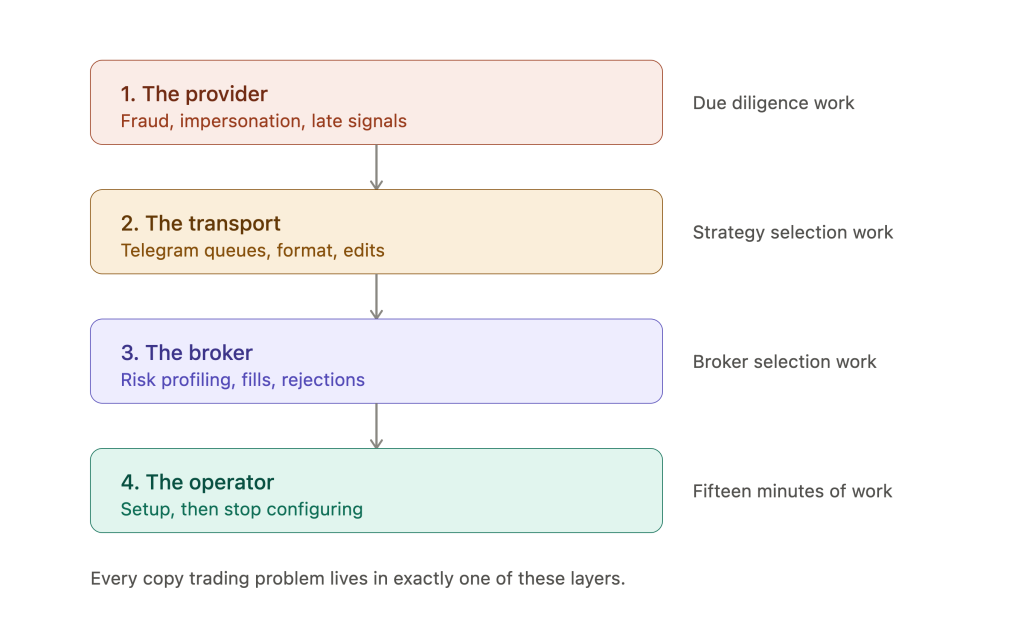
So here’s the terrain. Four layers. Every problem in Telegram copy trading lives in exactly one of them, and the traders who do well are the ones who can tell which.
Telegram is an extraordinary place to find signal providers and an extraordinary place to get robbed, and these are the same fact viewed from different angles.
The platform has no identity layer worth the name. A username is a username. A channel with 40,000 subscribers might have bought 39,500 of them for the price of a nice dinner. Track records are screenshots, and screenshots are pixels, and pixels are free.
We know this intimately, because it happens to us. There are people on Telegram right now impersonating our company — using our name, our branding, selling signals and an EA — to take money from traders who think they’re talking to us. We have no special protection here. Neither do you.
The work at this layer is due diligence, and it’s not optional.
The uncomfortable question isn’t “does this provider win?” It’s “does this provider exist, and is the person messaging me that provider?” Only after that do you get to the real question, which is whether the track record is a track record or a memory of one.
This is why we built mltiplAI: to make channel performance verifiable rather than claimed. Actual signal history, actual outcomes, actual drawdown, computed from the messages themselves rather than transcribed from someone’s marketing deck. Not because we enjoy building analytics platforms, but because the alternative — trusting screenshots — is how people lose accounts before a single trade is copied.
A related expectation problem belongs here too, because it’s a provider problem wearing a software costume: our system copies signals. It does not anticipate them. If your provider sends a XAUUSD entry eleven minutes after the level printed, you get an entry eleven minutes late, because that’s when the signal existed. Our software has no opinion about the market. It has no hindsight. It cannot know that the trade would have been beautiful at 09:14 when the message arrived at 09:25. Some providers copy other providers, adding their own latency on top; we can’t see that either. We work with what Telegram hands us, at the moment Telegram hands it to us.
That’s not a limitation we’re apologizing for. That’s the definition of copying.
Here’s the thing about Telegram: it’s a messaging app. It was built to send your friend a photo of a dog. It was not built to be a low-latency financial market data feed, and it has never once claimed to be one.
This matters more than anything else in this article, so we’re going to be blunter about it than our competitors will.
There’s no standard for what a signal looks like. There are conventions — entry, stop loss, take profit, maybe a couple of TPs, maybe some emojis, maybe a paragraph of motivational content about how the market rewards the patient, and how the signal provider is buying a new car with the money you sent. But no standard.
This used to be a genuine engineering problem. It’s substantially less of one now, because language models are extremely good at reading text that means something even when it’s formatted like nothing. Bold markdown, weird line breaks, “TP1 @ 1.0850 🔥🔥” — the parser handles it.
Not a solved problem. But close enough that it shouldn’t be your top concern.
A provider posts a signal. Twenty minutes later, they reply to it: “move SL to BE.” Also in the channel, someone replies to the same signal with “nice one bro 🚀.”
One of those is an order modification. One is not. Telling them apart is genuinely hard, because both are replies, both reference a live trade, and neither is labeled.
We route replies down an entirely separate processing path from new signals. The system’s first job isn’t to execute the reply — it’s to decide whether the reply is an instruction at all. Chatter gets discarded. Valid edits get applied. This is one of the parts of the system we’re most quietly proud of, because when it works, nobody notices, which is exactly what you want from infrastructure.
Our system is fast. Our order submission through MetaAPI is fast. We’ve engineered both of those for speed and we’ll defend the numbers: 35ms processing time. Anyone who claims to be faster than 30ms is lying to you–the best solutions architects in the trading world shoot for 30ms execution speed. That’s the limit.
But we are two parts of a three-part system, and we do not control the third.
Telegram’s API can be slow. Not milliseconds-slow — minutes-slow. If you’re following a busy channel, or Telegram has assigned you to a congested datacenter, delivery delays of up to ten minutes are possible. Not typical. Possible. And when it happens, there is no amount of engineering on our side that fixes it, because the message simply does not exist for us until Telegram decides to hand it over.
Every vendor in this space knows this. Most of them won’t say it, because it’s easier to sell “lightning fast execution” and let you find out on your own.
So here’s what we tell prospective customers who want to scalp gold: don’t.
Not because our software can’t handle it. Because you are asking a message app, a copier, and a broker’s execution engine — three independent systems, each with its own queue — to cooperate on a timescale where a two-second delay ruins the trade. Too many software layers. The strategy and the transport are incompatible, and no amount of optimization reconciles them.
The work at this layer is strategy selection. Swing trades survive Telegram. Intraday positions with sensible stop distances survive Telegram. Scalping XAUUSD does not survive Telegram, and choosing to do it anyway is choosing to be angry later.
Pick strategies that tolerate the transport you’re actually using. This is the single highest-leverage decision in the entire pipeline, and it costs nothing but honesty.
Most copy traders think of their broker as a neutral pipe. Orders go in, fills come out. Plumbing.
Your broker is not plumbing. Your broker is a business with a risk department, and you are a line item in it.
We know this because we have built those systems. Our risk automation platform runs at regulated forex brokers, doing exactly what you’d expect: monitoring exposure, classifying flow, deciding what gets hedged to the market and what stays on the book. We wrote the software that watches you.
Here’s what that means in practice.
When you fund your account, you get classified. Not judged, not punished — classified. Brokers assign risk profiles based on your behavior: deposit size, trade frequency, instrument selection, win rate, holding time, correlation with other clients’ flow. That profile determines how your orders are handled downstream.
Two clients can send an identical order and get different treatment, because they’re in different risk buckets. That’s not a conspiracy. That’s a broker managing a book, which is the entire business model, and which is disclosed in documentation nobody reads.
Your risk profile determines your fills. Some flow goes straight to a liquidity provider. Some gets internalized. Some gets scrutinized. The result is that “the market moved” and “your broker’s execution logic did a thing” can look identical from the outside and produce very different outcomes on your statement.
Sometimes orders get refused. Rejections, requotes, “market closed,” minimum distance violations, maximum exposure limits, instrument-specific restrictions. These are legitimate broker mechanics. They are also, from the copier’s perspective, indistinguishable from cosmic rays — we send the order, the broker declines it, we log the decline. We can tell you that it was rejected. Only your broker can tell you why.
Copy trading amplifies all of this, because a copier sends orders in patterns that look nothing like manual trading. Same instrument, same direction, same second, across many clients following the same channel. If you were a broker’s risk system, you’d notice that too. We know, because we built the thing that notices.
The work at this layer is broker selection and expectation management. Read your execution policy. Know whether you’re on an A-book or a B-book. Know your instrument restrictions before your strategy depends on them. And when a trade doesn’t fill, understand that the copier is the messenger, not the decision-maker.
This is our favorite layer, because it’s the one where we did everything right and it didn’t help.
Once upon a time, symbol mapping was manual. Your provider says “GOLD.” Your broker calls it XAUUSD.m. Somebody has to connect those two facts, and that somebody was you.
Predictably, users didn’t do it. Trades didn’t open. And the support ticket read, in its entirety:
your software is junk
Fair enough. Manual configuration is friction, friction is our problem, so we built automapping. The system now queries your broker directly, discovers the actual symbol for gold on your actual account, detects the suffix, and prepopulates the map. Default output is XAUUSD. If your broker calls it something else, we find out and handle it. No user action required.
Problem solved.
Except now users — who did not read the documentation explaining that the mapping is automatic — go into the settings and build a symbol map by hand. Which sits on top of the automatic one. Which creates a conflict. Which means trades don’t open.
And the support ticket reads, in its entirety:
your software is junk
The same accusation. The same symptom. The exact opposite cause. We eliminated the problem of doing nothing and replaced it with the problem of doing too much, and from the user’s chair these are literally identical, because in both cases the outcome is no trades and the villain is us, lol.
We’re not telling this story to dunk on anyone. We’re telling it because it contains the most useful diagnostic in this entire article:
At this layer, the fix is usually to remove something, not add something.
If your trades aren’t opening and you’ve configured things, un-configure them. Let the automatic system do the job it was built for. The instinct to fix a problem by adding configuration is correct in most software and wrong in this one.
Same category, different mechanism.
Your provider entered EURUSD at 1.0850 on a raw-spread ECN. Your broker is showing 1.08507. Is that the same trade? Sort of. Not exactly. The difference is small, and it compounds, and across a month it’s the difference between the provider’s published results and yours.
Our system compensates for this. Dynamic order flow adjusts for spread and entry divergence between the provider’s execution environment and yours, because a signal is a decision, not a price, and blindly firing at a price that exists on someone else’s broker is how you accumulate slippage or rejections nobody accounts for.
Users complain about this. Specifically, they complain when the adjustment doesn’t go their way — when the compensated entry misses a move that the raw entry would have caught.
Which is hindsight bias wearing a technical costume. The adjustment is doing its job on every trade, including the ones where it looks wrong afterward, and especially on the ones where it looks wrong afterward, because those are the trades where your broker’s price and your provider’s price disagreed most — which is exactly the condition the system exists to handle.
The system isn’t optimizing for the trade you’re currently annoyed about. It’s optimizing for the distribution.
Every problem in Telegram copy trading lives in one of four layers:
The firms doing this at institutional scale employ actual humans for each of those four layers. Our software collapses most of it into infrastructure you never think about. But it can’t collapse all of it, because layers one and three are other people’s businesses and layer two is a messaging app owned by someone who has never heard of you.
What’s left is yours. It isn’t much, and it isn’t hard, but it isn’t nothing — and pretending otherwise is what the “passive income” marketing does, right up until the moment you find out.
The traders who do well at this aren’t the ones with the best signals. They’re the ones who, when something goes wrong, can tell you which layer it went wrong in.
That’s the whole skill. Everything else is software.
TelegramFX Copier is a cloud-based Telegram-to-MT4/MT5 signal copier. No VPS, no EA babysitting, no manual symbol mapping. Start a trial — and read the two paragraphs about symbol maps.
 Sign in